Hemant Julka on Making Enterprise AI Deliver Real Value
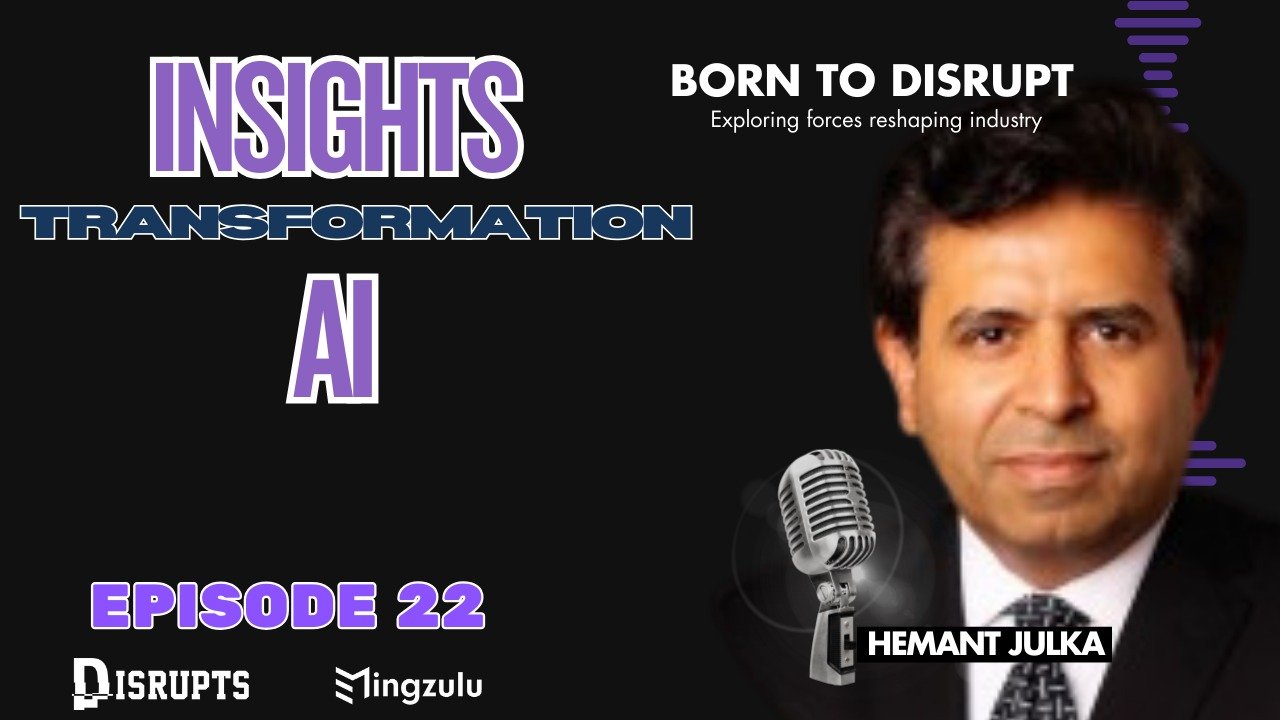
In this episode of the Born to Disrupt podcast, hosts Grant Niven and Simon Hardie engage with Hemant Julka, a seasoned expert in AI and enterprise technology, to explore the practical execution of AI within businesses. The discussion delves into the importance of foundational elements like data governance and security, the challenges of AI adoption, and the evolving talent landscape in the Middle East.
From Modems to Multipliers: Hemant Julka on the Reality of Enterprise AI
The rapid ascent of generative AI has left many boardrooms scrambling to move beyond experimentation and into a phase of tangible value. However, for Hemant Julka, a veteran technology leader and former executive at Emirates NBD, the path to successful deployment is not found in chasing the latest model, but in a rigorous, foundations-first approach that treats the technology as a multiplier of an existing enterprise's strengths and weaknesses.
Speaking on the Born to Disrupt podcast with hosts Grant Niven and Simon Hardie, Julka explained that the current state of AI mirrors the early days of the internet. We are at the modem stage, he said, referring to the era of slow, dial-up connectivity. While the transition from modems to mobile apps took two decades, the AI evolution is compressed into a window of approximately two years. This acceleration places immense pressure on traditional organisations to modernise their operating models or risk scaling their existing inefficiencies.
Avoiding the "POC Theatre"
A primary hurdle for large organisations is the temptation of what Julka describes as "POC theatre"—the creation of simple chatbots or wrappers around large language models (LLMs) that provide a veneer of innovation without delivering fundamental business value. While these projects help teams understand the technology, they often ignore the structural realities required for production-grade software.
"AI is a multiplier of whatever your enterprise already is, including risk," Julka commented. If an organisation's data is fragmented, controls are inconsistent, or residency is unclear, the result is not a smarter business, but "fast mistakes at scale". To combat this, he advocates for a focus on "data debt," a concept parallel to technical debt. Over the last 20 years, banks and airlines have focused on maintaining application landscapes, but the current era requires a focus on the veracity and hygiene of data to ensure it is sanitized and compliant with regional regulations.
The Sovereignty Challenge in the GCC
For businesses operating in the Middle East, particularly within the GCC, the conversation around AI is inseparable from data sovereignty. Julka noted that sovereignty is about control rather than just physical location. During early experimentation with global providers, he encountered challenges where data flows were not fully transparent—specifically whether prompts were being processed within the country or sent to international servers.
This lack of clarity often forces a pivot toward a hybrid approach. "The inability of providers to tell us where the data flows were resulted in us realising some solutions were not viable," Julka explained. This has led to a rise in on-premise solutions and the procurement of private GPU clusters to run open-source models, ensuring that sensitive customer data remains within the regulatory boundaries of the Central Bank of the UAE.
Building a Two-Speed Culture
Bridging the gap between legacy systems and AI-driven agility requires a "two-speed" organisational structure. Julka suggests that enterprises must maintain sandbox environments for experimentation that remain separate from production systems but are still held accountable to specific KPIs.
This cultural shift is driven by executive education. Innovation must be rooted in teaching leadership to speak the same technical language, allowing them to set high aspirations while understanding the underlying risk economics. Julka shared that for one of the largest banks in the UAE, a three-day hackathon involving 80 business colleagues and 30 engineers resulted in 21 prototypes, several of which were approved to move into production.
The Shift Toward Agentic Architecture
As the industry moves toward agentic AI—where models do not just respond to prompts but execute complex workflows— the likes TOGAF and their Enterprise Architecture frameworks are becoming highly relevant again. Julka believes this is the best time for practitioners to apply these decades-old constructs to modern AI to ensure integration across enterprise APIs.
In the immediate term, value is being found in vertical applications like research analytics for CFOs and the strengthening of outbound contact centres. However, the long-term success of these initiatives depends on the talent pipeline. Julka, who is currently pursuing further studies at Cornell Tech, emphasised the need for "digital bridges" between enterprises and academia hubs like Hub71 or the DIFC Innovation Hub.
For leaders weighing an investment in 2026, Julka offers three questions: what specific interaction / capability / workflow is changing, what is the baseline KPI, and do the controls exist to run it safely? Beyond the choice of the model, it is the unit economics of each interaction and the cost of failure that will define the winners in the AI race.