Orbital Q3 Index Shows Stablecoin Retail Payments Maturing with Organic Growth
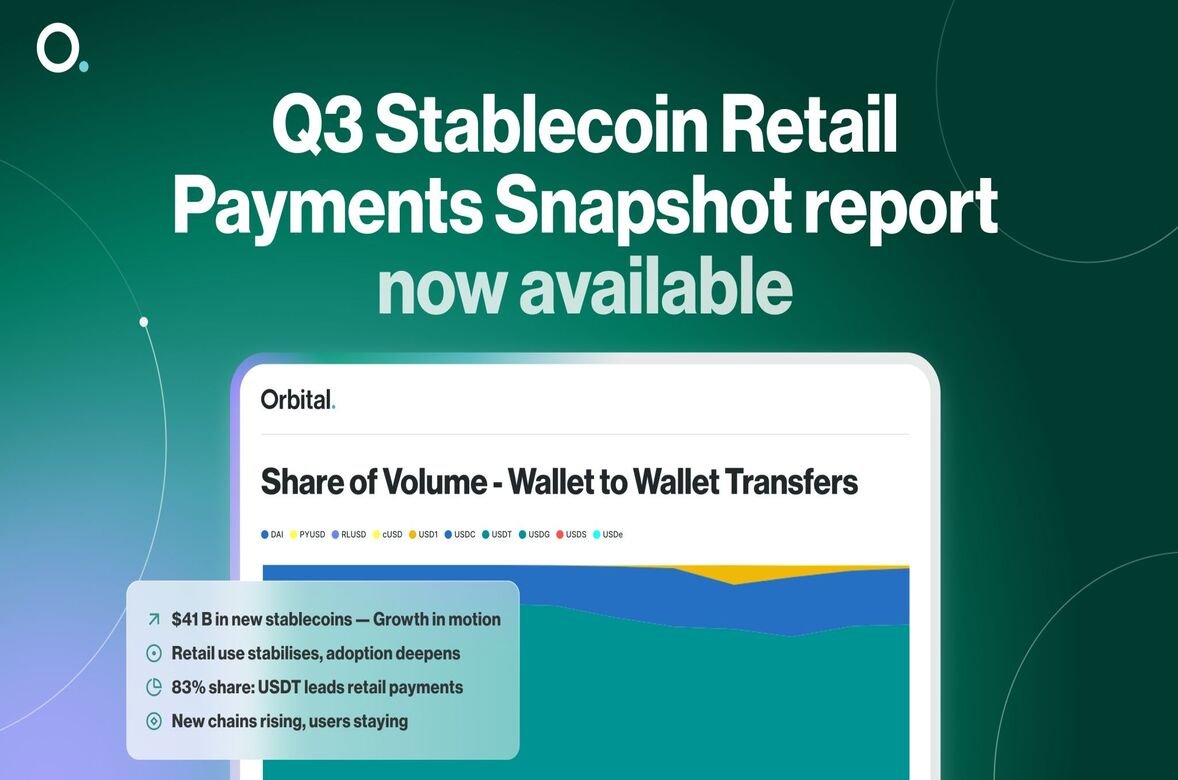
Orbital’s Q3 Stablecoin Retail Payments Index highlights steady adoption as retail activity cools from incentive-driven peaks. USDT dominates retail payments, USDC leads in DeFi, and genuine P2P, merchant, and SME transactions are driving sustainable growth.
Orbital, a global payment orchestration platform across stablecoins and traditional payment rails, today released its Q3 Stablecoin Retail Payments Index snapshot. With data sourced from Artemis, the Index reveals a sector that’s maturing, with explosive launches balanced with a transition to more sustainable, organic activity.
The Index tracks both the pace and quality of adoption across retail stablecoin payments, offering one of the most comprehensive snapshots of the sector’s evolution.
Key findings include:
Plasma sets a $7 billion deposit record post-launch
Plasma launched its native token, XPL in Q3. Within just three days, it surpassed $7 billion in stablecoin deposits, setting a new record for a newly launched Layer 1 blockchain. However, it remains in the early adoption phase, and transaction volumes are stabilising after the initial hype.
BSC retains leadership in retail transfers though growth slows by 50%
Meanwhile, more established networks continued to shape retail stablecoin activity in different ways. Binance’s BNB Chain (BSC) maintained its dominance in retail transfers, particularly for low-value, high-frequency payments, though growth slowed by 50% compared to the previous quarter.
Aptos, which surged in Q2, has plateaued, however retained its higher transaction baseline in Q3. Sustained daily activity, steady P2P volumes, and a rising average transaction size indicate that users are engaging in real economic activity.
Stablecoin retail market cools, but genuine payment flows grow
The retail stablecoins market steadied in Q3. After a Q2 surge driven by incentive programmes and promotional spikes, total transaction counts eased from 1.33 billion to 1.21 billion, while daily active users stabilised at 3.6 million. Despite this cooling, both figures remain well above early 2025 levels.
As active wallet count flattens, average transaction size is rising. While retail activity may have cooled following incentive-driven peaks, the underlying trends point to steady, organic growth as stablecoins continue to carve out a real role in retail payments.
Importantly, the gap between adjusted and unadjusted volume has narrowed significantly, from 50% to 44%, when speculative trading is filtered out to focus on P2P payments, remittances, merchant payments and SME transfers. This would suggest a healthier, more authentic flow of funds, with genuine settlement and payments now driving a larger share of throughput.
USD1 retraces to ~1% of retail transfers after Q2 boom
The pattern is echoed in the case of USD1, whose share of retail-sized wallet-to-wallet transactions under $10,000 dropped from 6% in Q2 to around 1% in Q3. Sharp, temporary surges in activity followed by a plateau indicating incentive programmes.
DeFi vs retail payments divergence
A clear split is emerging between DeFi and retail payments. USDC has become the stablecoin of choice for DeFi, commanding over 50% of market share in on-chain lending, liquidity pools and institutional settlements. Average transactions are larger but less frequent, suggesting fewer but larger settlements.
USDT, by contrast, remains the preferred retail payments token – extending its dominance slightly to 83% of market share in Q3. It shows broad distribution, with 64% of supply held in self-custodied wallets and 30% in small retail balances between $10-$100.
Together, USDT and USDC anchor most stablecoin activity. As major centralised exchanges including Binance continue to serve as a primary source of stablecoin liquidity, solutions like Binance Pay cashier integrations become a practical option for facilitating stablecoin payments across both retail and institutional use cases.
Luke Wingfield Digby, Co-Founder & Head of Corporate Development at Orbital, said: “After months of incentive-driven spikes, activity is now settling into a more sustainable rhythm - one defined less by speculation and more by everyday use. Stablecoins are no longer just about growth; they’re about utility. The next step is making stablecoins usable everywhere - bridging networks, use cases, and geographies so that they become a truly universal payment layer.”
Stablecoin premiums
Premiums - the rate retail users pay to buy US-dollar backed stablecoins compared to the local US dollar exchange rate - correlate closely with local liquidity infrastructure. The average global retail premium across all markets was 4.5% in Q3, but this was driven by outliers which saw high premium expansions between July and September - Venezuela (+34.6%), Türkiye (+10.16%) and Argentina (+6.03%).
Markets reliant on informal P2P channels face higher markups, reinforcing the role of regulated fiat gateways and liquidity providers in stabilising stablecoin pricing.
A link to the full Q3 2025 Stablecoin Retail Payments Index, with more details of these and other insights, can be found here.